Where was the first bitcoin ATM?
UTXOHub · Bitcoin's history
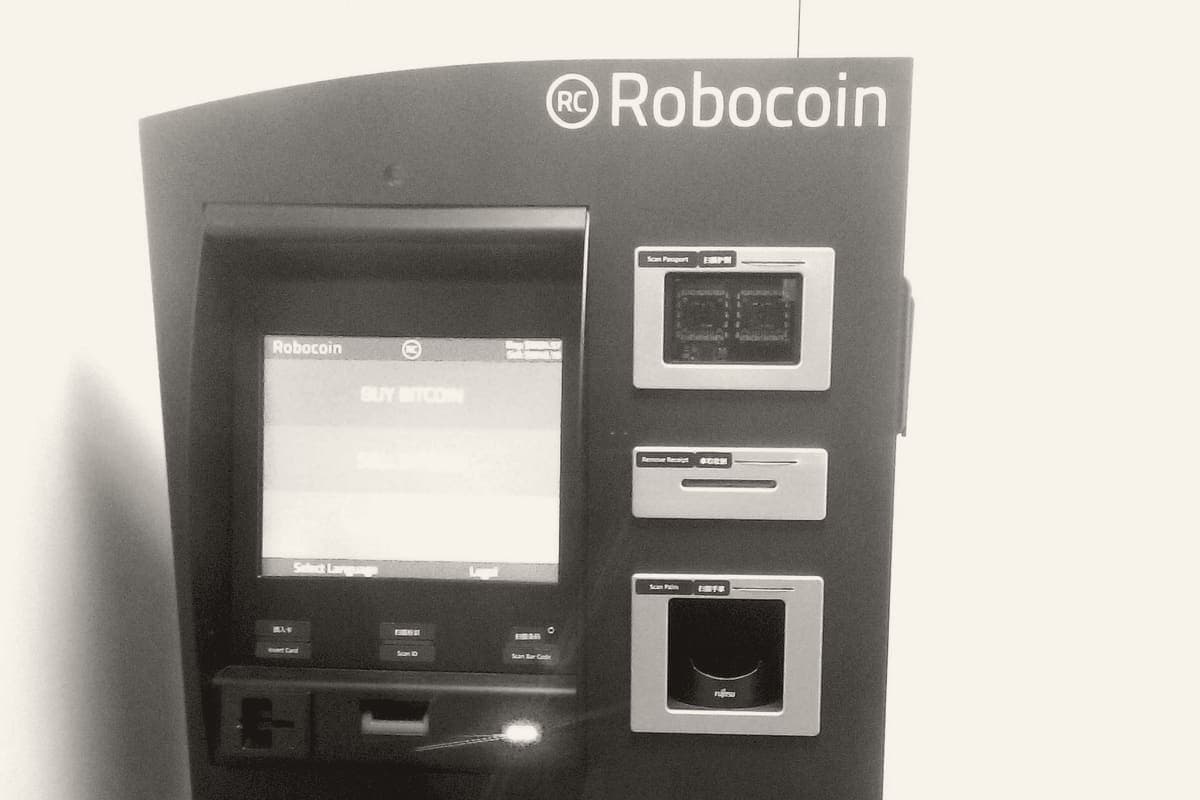
In a Waves Coffee House on Howe Street in downtown Vancouver, Canada. On 29 October 2013 a machine built by the Nevada company Robocoin opened there, swapping Canadian cash for bitcoin, and bitcoin for cash, for anyone who scanned their palm. Tens of thousands of such machines followed around the world. Thirteen years on, regulators warn that scammers use them to take victims' money, and Canada has proposed banning them.
Who brought it to Vancouver
In 2013, buying bitcoin in Canada was slow. Most people opened an account with an online exchangeExchangeA business where people swap ordinary money for bitcoin and other coins. Coins left there are held by the exchange, which controls their keys., a website that swaps ordinary money for bitcoin, and waited, sometimes for more than a week, while it checked who they were. Others bought from strangers. Ryan Johnson, from Vancouver, paid cash for his first bitcoins to someone he had met online. “It was almost like a sketchy drug deal,” he told the Canadian Press.
Mitchell Demeter, a 27-year-old Vancouver businessman, began trading bitcoin among friends in January 2013, BC Business reported. That summer he and two friends from his high school in Sechelt, a small town in British Columbia, opened Bitcoiniacs, a shop where people could buy and sell bitcoin in person. One of them was Jackson Warren. Then they heard about Robocoin's machines. “They're basically our store, but automated,” Demeter told Wired.
Robocoin was a small Las Vegas company. Its chief executive, Jordan Kelley, the son of a casino executive, had passed on a casino career to build bitcoin machines, Desert Companion magazine reported. “Our goal is to make Bitcoin truly grandma-friendly,” he told the Canadian Press. The three Bitcoiniacs partners paid $18,500 each for five Robocoin machines.
The first reached the Waves Coffee House on Howe Street, next to the provincial courthouse, on Monday 28 October. It weighed 750 pounds, about 340 kilograms, so it helped that Demeter also owned a moving company, Wired reported. For a few anxious minutes the partners thought it had come without a power cord, until they found one inside, and Wired's reporter found its key lying on a café table. “Oh my god, give me that,” said Warren. “I'm so bad with keys.”
How it worked
The machine looked like a bank's cash machine but was linked to no bank and took no cards. “You put your money in, and it gives you numbers — addresses that link to bitcoins,” Wired explained. A buyer fed in banknotes and held up a phone showing a QR code, a square barcode, for a bitcoin addressAddressA string of letters and numbers that tells someone where to send you bitcoin, a bit like an account number for one payment., which works a bit like an account number, in their walletWalletAn app or device that holds your keys and makes, signs and sends payments. The bitcoin itself stays on the blockchain., the app that holds the keys to their bitcoin. The machine bought the coins on the spot and sent them there.
Anyone without a wallet could have the machine print a paper one: a new address and its private keyPrivate keyThe secret number that lets you spend your bitcoin. Whoever knows it controls the coins, so it must never be shared., the secret code needed to spend from it, Robocoin's website said. Selling worked the other way round, with cash paid out once the network had confirmedConfirmationA payment has one confirmation once it's in a block, and one more for each block after. The more it has, the harder it is to reverse. the customer's payment. Behind the screen the machine traded on an exchange; Robocoin offered operators a link to Bitstamp or to Mt. Gox, the Tokyo exchange that collapsed four months later.
The palm scanner was the safeguard. It took “a unique, anonymous (no fingerprints) infrared picture of a customer's blood vessels”, Robocoin said, so the machine could recognise people and cap what each traded at 3,000 Canadian dollars (C$3,000) a day. In Canada that was the only check: “You don't need any form of identification to use the ATM,” Wired reported. The machine could also scan a government ID card and match the customer's face to its photo, steps Robocoin called “Scan” and “Smile”.

The limit was meant to stop money laundering. Weeks earlier, American authorities had shut down Silk Road, an online drugs market where buyers paid in bitcoin. “We don't want drug dealers sending a bunch of coke to the States and then withdrawing cash,” Warren told Wired.
The machine charged a flat fee of 3%, BC Business reported. On opening morning, by CBC's figures, Bitcoiniacs was selling bitcoin for 13% to 15% more than it would pay to buy it back.
Why Vancouver
Canada was chosen for its rules. In the United States, a business swapping cash for bitcoin typically had to register with federal and state regulators as a money transmitter, like a firm that wires money. “The regulations right now in the United States are a pretty decent barrier to entry for any operator,” Kelley told Wired. Robocoin told Reuters that Canada had enough bitcoin users and lighter oversight.
Canada's anti-money-laundering agency, the Financial Transactions and Reports Analysis Centre of Canada (FINTRAC), did not treat bitcoin as money. It was “neither funds, nor the currency of a country,” a FINTRAC spokesman, Peter Lamey, told Wired. “Just operating a private-label ATM isn't subject to the requirements.” Demeter told Reuters that Bitcoiniacs already followed the guidelines FINTRAC would impose, including checks on customers' identities. Parliament changed the law in 2014, but businesses “dealing in virtual currency” had to register with FINTRAC and report suspicious transactions only from 1 June 2020, the Canada Gazette records.
Demeter told the Globe and Mail that he picked this Waves “because they accept Bitcoin as payment” and because it kept long hours. Its owner, Judy Fujiki, a 53-year-old schoolteacher, had not heard of bitcoin until that summer. Now she was buying it, and her colleagues at school were “horrified”. “I feel that I have always missed the boat,” she told Wired. “But now I am glad to be given the opportunity be a pioneer in this.”
The first customers
Getting the machine working took about seven hours that Monday, with Wired's reporter watching: its software started in safe mode, the receipt printer failed at first and the exchange it traded through briefly went down. That evening Jason Lamarche, an account manager at a bank, waited more than three hours to be its first customer. He slid in a $20 note and, in less than a minute, had a tenth of a bitcoin, which he used at the counter to buy a steamed milk with vanilla. “It was amazing,” he said. “It was super convenient. It was easy to use.”
The official opening was at 9 a.m. on Tuesday 29 October, and dozens of people came to see how it worked, CBC reported. Who had been first was soon argued over on Twitter, where Lamarche posted: “I'm the first consumer in the world to use a #bitcoin ATM,” HuffPost B.C. noted. Another customer, David Lowy, paid the barista 0.0101 bitcoin for a $2 cup of dark coffee, Agence France-Presse reported.
The machine was busy from the start. On its first day it handled 81 transactions worth $10,000, GeekWire reported. Within a week it had handled $81,000, beating Robocoin's target for the whole first month, and on its 29th day it passed C$1 million, from 1,576 transactions. More than half of those buying bitcoin there were buying it for the first time.
Was it really the first?
Kelley called it the first permanent bitcoin ATM, Wired reported, and the qualifier mattered: Robocoin had already run one in public as a demonstration at a bitcoin conference in San Jose, California, that May. In April, Jeff Berwick, a media entrepreneur, had told CNN Money that he expected to open the first two bitcoin ATMs, in Los Angeles and Cyprus, “in the next two weeks”. Neither opened, Bank Innovation reported, after trouble over a licence and a split between the partners.
A rival maker, Lamassu, said on 3 October 2013 that it had shipped its first machine to a customer in Atlanta, CoinDesk reported. But as the Robocoin arrived at Waves, Wired wrote: “As far as we know, this will also be the first operational Bitcoin ATM on the planet.”
What came next
Robocoin grew fast, to 70 machines from Las Vegas to Tel Aviv and Tokyo by November 2014, Desert Companion reported. But operators complained of late deliveries and faulty machines, and some moved their machines to other companies' software, CoinDesk reported. Adam O'Brien, president of Bitcoin Solutions in Alberta, paid $25,000 in January 2014 for a machine that never came. “If you need a refresher, we paid for an ATM 19 months ago and still do not have it,” his company wrote in 2015. After another buyer complained on Reddit, a discussion website, Robocoin's Kelley gave a full refund and told CoinDesk: “It should not have taken Reddit's wrath for me to realize the extent of my mistakes and take long overdue accountability.”
By then Robocoin had renamed itself Romit and turned to sending money abroad. In January 2016 it told customers that it was dropping bitcoin: “Please withdraw your bitcoin immediately by logging into your wallet,” CoinDesk reported.
The Waves café kept a bitcoin ATM, but not the Robocoin. On Coin ATM Radar, a website that maps bitcoin ATMs, it was machine number 1. By July 2015 its listing named a machine from another maker, General Bytes, still run by Bitcoiniacs. In January 2021, the last archived copy, it was online and charged C$9 plus 7.5% to buy bitcoin. Demeter, the Bitcoiniacs co-founder, joined Netcoins, a Canadian bitcoin broker, in 2018; its chief executive said he had “started the global Bitcoin ATM industry right here in Vancouver in 2013”.
Bitcoin ATMs multiplied. By Coin ATM Radar's count, there were 10 bitcoin ATMs in the world at the start of 2014, about 4,100 at the start of 2019 and more than 39,000 by August 2022.
Bitcoin ATMs and scams
As their numbers grew, scammers found a use for them. Criminals give a victim “detailed instructions”, the FBI says, “including how to withdraw cash from their bank, how to locate a kiosk, and how to deposit and send funds using the kiosk”, sometimes with a QR code the victim did not make.
The US Federal Trade Commission found that reported losses at the machines grew “nearly tenfold from 2020 to 2023”, and that people aged 60 and over were more than three times as likely as younger adults to report a loss. In 2025 the FBI received more than 13,400 complaints involving crypto ATMs, with losses of over $388 million, though some of that money also moved in other ways.
In March 2022 the UK's financial regulator, the Financial Conduct Authority (FCA), said it had approved no firm to run crypto ATMs, “meaning that any of them operating in the UK are doing so illegally and consumers should not be using them.” In February 2025 Olumide Osunkoya was sentenced to four years in prison for running unregistered machines at 28 locations, with a typical markup of 30% to 60%. By the FCA's count, the UK went from more than 80 advertised crypto ATMs in 2022 to none in 2024.
Canada has more crypto ATMs per person than any other country, and FINTRAC concluded in 2023 that they had become the main way fraudsters get money from scam victims, CBC News reported. On 28 April 2026 the government proposed banning them as “a primary method for scammers to defraud victims and for criminals to place their cash proceeds of crime”. Operating one would become a criminal offence, though people could still buy bitcoin from registered businesses with shops.
Operators say they have tightened up. Bitcoin Depot, the largest in North America, said it had brought in “enhanced identity verification, customer fraud warnings” and lower limits. Even so, on 18 May 2026 it filed for bankruptcy protection and switched off its network, which had more than 9,000 machines in 2025, blaming state limits, bans and lawsuits: “the Company's current business model is unsustainable.” Indiana had banned the machines in March, and Minnesota's ban followed in August.
In Canada, Adam O'Brien, the Alberta operator who never got his Robocoin, runs the same company under a new name, Bitcoin Well, with more than 150 machines. “I don't think that anyone thinking about this for more than two seconds is under the impression that getting rid of Bitcoin ATMs stops fraud in Canada,” he told BetaKit, pointing to unskippable fraud warnings on his machines. Koleya Karringten, executive director of the Canadian Bitcoin Consortium, asked for a consultation and proposed a smaller step: ending anonymous cash purchases under $1,000.
The number of machines is falling. Coin ATM Radar counted 38,928 crypto ATMs worldwide on 29 March 2026, Bitcoin.com News reported, and 27,358 by late September, “a level not seen since 2021”. Canada's ban would need Parliament to change the law. If it does, running a machine like the one that opened on Howe Street in 2013 will become a crime in Canada.
References
- CBC News (The Canadian Press), “Bitcoin kiosks coming to five Canadian cities”, 8 September 2013.
- BC Business, “Vancouver to Get Canada's First Bitcoin ATM”, 10 September 2013.
- Wired, “World's First Bitcoin ATM Set to Go Live Tuesday”, 25 October 2013.
- Desert Companion (KNPR), “Geek it up”, 1 November 2014.
- Wired, “World's First Bitcoin ATM Arrives at Coffee Shop, Goes Live Tomorrow”, 28 October 2013.
- Wired, “Take a Tour of Robocoin, the World's First Bitcoin ATM”, 29 October 2013.
- Robocoin (Wayback Machine copy), “Bitcoin's First ATM”, 30 October 2013.
- CBC News, “World's first bitcoin ATM opens in Vancouver”, 29 October 2013.
- Reuters (via NBC News), “Bitcoin goes mainstream with ATM in Vancouver coffee shop”, 30 October 2013.
- Canada Gazette, Part II, “Regulations Amending Certain Regulations Made Under the Proceeds of Crime (Money Laundering) and Terrorist Financing Act, 2019”, 10 July 2019.
- The Globe and Mail, “Bitcoin picks Vancouver for its first ATM”, 28 October 2013.
- HuffPost B.C. (Wayback Machine copy), “Bitcoin ATM In Vancouver Makes Waves”, 30 October 2013.
- Agence France-Presse (via The Daily Star), “'World's first' bitcoin ATM opens in Canada”, 30 October 2013.
- GeekWire (Wayback Machine copy), “World's first Bitcoin ATM exceeds $1M in transaction volume within one month”, 26 November 2013.
- CNN Money (Wayback Machine copy), “Bitcoin ATMs coming soon”, 4 April 2013.
- Bank Innovation (Wayback Machine copy), “Bitcoin ATM in Canada Is the World's First — Or Is It?”, 31 October 2013.
- CoinDesk, “Lamassu ships first bitcoin ATM”, 3 October 2013.
- CoinDesk, “Robocoin Faces Lawsuit Over Bitcoin ATM Refund”, 3 August 2015.
- CoinDesk, “Former ATM Maker Robocoin Ends Bitcoin Services”, 15 January 2016.
- Coin ATM Radar (Wayback Machine copy), “Bitcoin ATM Vancouver - Waves Coffee House”, 14 July 2015.
- Coin ATM Radar (Wayback Machine copy), “Bitcoin ATM in Vancouver CA - Waves Coffee House”, 27 January 2021.
- Netcoins, “NETCOINS hires Mitchell Demeter as VP Partnerships and Business Development”, 19 March 2018.
- Coin ATM Radar (Wayback Machine copy), “Crypto ATM Installations Growth”, 9 March 2023.
- FBI Internet Crime Complaint Center, “IC3 Cryptocurrency Kiosk Complaint Data By State”, 15 May 2026.
- US Federal Trade Commission, “Bitcoin ATMs: A payment portal for scammers”, 3 September 2024.
- Financial Conduct Authority, “Warning on illegal crypto ATMs operating in the UK”, 11 March 2022.
- Financial Conduct Authority, “Olumide Osunkoya sentenced to 4 years for illegally operating crypto ATM network”, 28 February 2025.
- CBC News, “Federal government plans to ban crypto ATMs to stop scammers from defrauding Canadians”, 28 April 2026.
- Department of Finance Canada, “Spring Economic Update 2026, Chapter 2”, 28 April 2026.
- Department of Finance Canada, “Spring Economic Update 2026, Annex 2: Legislative Measures”, 28 April 2026.
- Bitcoin Depot (GlobeNewswire, via Channelchek), “Bitcoin Depot Initiates Voluntary Chapter 11 Process to Facilitate an Orderly Wind-Down and Sale of the Company's Assets”, 18 May 2026.
- Indiana Public Radio, “Emergency Declaration law ends Cryptocurrency ATM use in Indiana — sidelining about 800 units”, 17 March 2026.
- Minnesota House of Representatives, “Virtual currency kiosks to be banned in the state”, 2026.
- Bitcoin Well, “About”, read 18 October 2026.
- BetaKit, “Canada's plan to ban crypto ATMs worries industry, advocates”, 5 May 2026.
- Bitcoin.com News, “Crypto ATM Count Falls to 38,928 as 597 Machines Exit the Market in Q1 2026”, 29 March 2026.
- Bitcoin.com News, “Crypto ATM Numbers Fall to 2021 Levels Amid Regulatory Crackdown”, 27 September 2026.