Wei Dai.
Author of b-money, the first reference in the Bitcoin white paper
Wei Dai described b-money in 1998, a plan for internet money kept by its users instead of a bank, which Satoshi Nakamoto said Bitcoin implemented. Satoshi sent him the draft white paper in 2008; Dai later said he never got back to him.
Crypto++ and PipeNet
Dai studied computer science at the University of Washington. As a first-year student, he has written, he “decided to focus my education and career on applied cryptography”, and he worked in Microsoft’s cryptography research group, as an intern by his own account. In June 1995 he released Crypto++, a free library of cryptographic code that he wrote, he said in 2026, “to help secure the net against future rogue AIs”. The first version was withdrawn after RSA Data Security claimed a patent on the RSA algorithm, and he re-released it that November without the RSA code.[1][2][3][4][5][6]
He was also one of the cypherpunksCypherpunkSomeone who believes in using strong cryptography to protect people’s privacy. Many ideas behind Bitcoin came from the cypherpunks of the 1990s., programmers and privacy activists who argued on an email list for using cryptography to protect people’s privacy. In February 1995 he proposed there a way to hide who is talking to whom online, which he named PipeNet, because anonymous email was too slow for conversation: “Cryptoanarchy will not come about if people cannot do this anonymously.” He set it aside in 1998, mostly because the Onion Routing project, the forerunner of the anonymous browsing network Tor, “appears to be much better funded”.[7][8][9]
B-money
On 26 November 1998 Dai announced b-money on the cypherpunks list. It begins: “I am fascinated by Tim May’s crypto-anarchy.” Tim May, one of the list’s founders, had imagined online communities whose members could not be traced. Dai set out a way for such a community’s members to pay each other and enforce contracts “without outside help”. Everyone would be known only by a pseudonym, a public keyPublic keyThe partner of a private key. It lets anyone check a signature without revealing the private key under current computing assumptions.. “Anyone can create money by broadcasting the solution to a previously unsolved computational problem,” he wrote, and to pay, you would broadcast a message, signed with your key, saying how much you were giving to whom.[10][11][12][36]
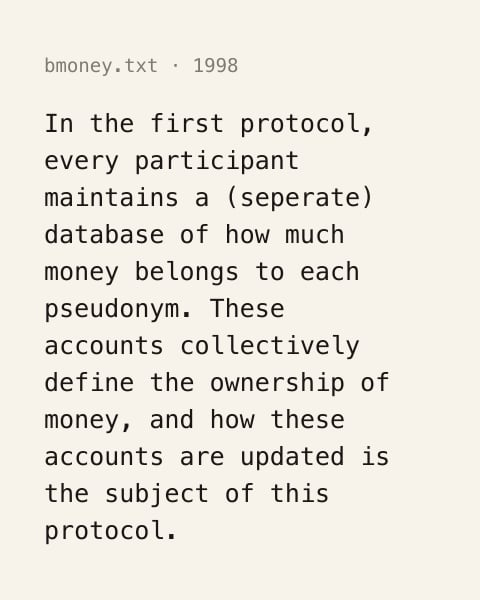
In the first version of b-money, every participant would keep “a (seperate) database of how much money belongs to each pseudonym”, much as every Bitcoin node keeps its own copy of the record today. Because that needed a broadcast channel nobody could block, he added a more practical second version, in which a group of servers, each putting up a deposit it could lose, kept the accounts. Contracts would name an arbitrator, and if the parties disagreed, each participant would weigh the case and adjust the accounts. Dai never built it: he “didn’t take any steps to code up b-money”, he said in 2014.[10][13]
Adam Back replied on the list that hashcash “would be a candidate function for Wei’s decentralised minting idea”, the link he would make again for Satoshi Nakamoto ten years later. Dai was already cooling on the politics behind it. “I now tend to think that the government monopoly of force is a net benefit,” he wrote in December 1998, and he expected that b-money “will at most be a niche currency”.[14][15]
Satoshi’s emails
On 22 August 2008, the day after Back told Satoshi about b-money, Satoshi wrote to Dai about a forthcoming paper “that expands on your ideas into a complete working system”. Satoshi asked when b-money had been published, guessing 2006, and included the abstract of the draft, then called “Electronic Cash Without a Trusted Third Party”. Dai replied that b-money had been announced in 1998 and said he would take a look. When the Bitcoin white paper appeared on 31 October, b-money was its first reference.[16][17][18]
What was the Bitcoin whitepaper?On 10 January 2009 Satoshi wrote again to say that Bitcoin v0.1 was out: “I think it achieves nearly all the goals you set out to solve in your b-money paper.” In July 2010 Satoshi went further, writing on the Bitcoin forum that “Bitcoin is an implementation of Wei Dai’s b-money proposal”, and of Nick Szabo’s bit gold. Dai paid little attention at the time. “I was more interested in Less Wrong than Cypherpunks at that point,” he wrote in 2014, meaning LessWrong, an online forum about reasoning and artificial intelligence where he has written ever since. In 2013 he admitted: “when Satoshi wrote to me asking for comments on his draft paper, I never got back to him.”[16][21][19][20]
Dai made the emails public in March 2014, after The Sunday Times quoted from them, saying he had “no objection to making them public myself”. They became evidence in 2024, in the case the Crypto Open Patent Alliance brought at the High Court in London against Craig Wright, who claimed to be Satoshi. Wright had said Dai’s work shaped his thinking for years. Dai, who declined to give a witness statement, told the alliance’s lawyers by email that Satoshi had learned of b-money only from Back, “so it seems wrong that I profoundly impacted Satoshi’s thinking”. He had never given Satoshi code, he wrote, although Bitcoin did use his SHA-256 code from Crypto++, the code that fingerprints Bitcoin’s blocks: Satoshi “probably just downloaded and used it without telling me”. The judge found Dai’s evidence “compelling”, and Wright’s account of their dealings “pure fabrication”.[22][16][17][23]
After b-money
Dai has said little about Bitcoin in public, and much of it critical. “I didn’t create Bitcoin but only described a similar idea more than a decade ago,” he wrote in 2011, when he bought a graphics card and started mining. In 2013 he judged that Bitcoin had “failed with regard to its monetary policy”, because its fixed supply made the price swing, and wondered whether, had he answered Satoshi, “perhaps I could have dissuaded him (or them) from the ‘fixed supply of money’ idea”. By the time he finished writing up b-money, he said in 2014, he “had actually grown somewhat disillusioned with cryptoanarchy”.[24][20][13]
On LessWrong in 2009 he proposed what became known as updateless decision theory, an approach to how an artificial intelligence should make decisions, which later research on the subject cites. He has come to doubt the value of his early work. “If one wants to push the future in a positive direction, it seems to me that there are better things to work on than Bitcoin,” he wrote in 2016, and in 2025 that “even some of my interests, e.g. in early cryptocurrency, might have been net-negative.” In 2015 he handed Crypto++ over to other developers.[25][26][27][28][29]
When Ethereum’s white paper set out the units of its currency in 2014, it called the smallest one the wei, beside units named the szabo and the finney. Dai himself keeps a low profile, and his website warns that “any purported photos of me on the Internet are actually of other people named Wei Dai”.[30][12]
Was he Satoshi?
Dai’s name has come up among possible Satoshis since Bitcoin’s early years, though no one has made a detailed case for him. In May 2011 Nick Szabo wrote that he, Dai and Hal Finney were the only people he knew who had pursued such ideas before Satoshi, “assuming Nakamoto is not really Finney or Dai”. Wired reported that year that some people believed Satoshi “must be one of the older crypto-currency advocates—Finney or Szabo or Dai”. In 2026 he was one of nine “well-known Satoshi suspects” in The New York Times’ investigation that named Adam Back, and one of the cypherpunks considered in the documentary Finding Satoshi.[31][32][33][34]
The emails are the main evidence against it. Satoshi asked Dai when b-money had been published and said Back had pointed the way to it, and the High Court accepted Dai’s account that Satoshi learned of b-money only that August. Alyssa Blackburn, the data scientist behind Finding Satoshi’s study of when Satoshi was online, said that analysis alone made it “inconceivable” that Back, Szabo or Dai could be Satoshi, DL News reported. Dai has denied it, Wired reported in 2011. Asked in 2014 who Satoshi was, he said he did not think it was Szabo “or anyone else whose name is known to me”.[16][17][34][32][35]
Reviewed . To report a mistake, email hello@utxohub.com.
Picture: A passage from b-money, Wei Dai’s 1998 proposal, describing a record of how much money belongs to each pseudonym. Wei Dai, set in type by UTXOHub.
More people
Before Bitcoin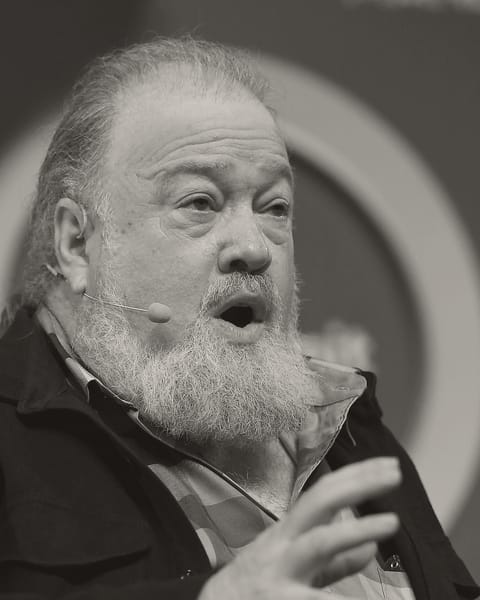


References
- LessWrong (Wei Dai), “Trying to understand my own cognitive edge”, 3 November 2025.
- VoteHere (Internet Archive copy), “Advisory board: Wei Dai”, 2000.
- LessWrong (Wei Dai), “Comment on “Open Thread, August 2010””, 6 August 2010.
- Crypto++ (Internet Archive copy), “Crypto++ Library: All Downloads”.
- Cypherpunks mailing list (Wei Dai), “Crypto++ 1.1”, 4 November 1995.
- LessWrong (Wei Dai), “Comment on “Habryka’s Shortform Feed””, 23 August 2026.
- Cypherpunks mailing list (Wei Dai), “a new way to do anonymity”, 7 February 1995.
- Cypherpunks mailing list (Wei Dai), “PipeNet description”, 20 January 1998.
- USENIX Security Symposium (Tor Project archive), “Tor: The Second-Generation Onion Router”, 2004.
- Wei Dai’s website, “b-money”.
- Cypherpunks mailing list (Internet Archive copy), “PipeNet 1.1 and b-money”, 26 November 1998.
- Wei Dai’s website, “Wei Dai’s Home Page”.
- LessWrong (Wei Dai), “Comment on “AALWA: Ask any LessWronger anything””, 15 March 2014.
- Cypherpunks mailing list (Adam Back; Internet Archive copy), “Re: Wei Dei’s “b-money” protocol”, 6 December 1998.
- Cypherpunks mailing list (Wei Dai; Internet Archive copy), “Re: Wei Dei’s “b-money” protocol”, 7 December 1998.
- Gwern.net, “Wei Dai/Satoshi Nakamoto 2009 Bitcoin emails”, 17 March 2014.
- Courts and Tribunals Judiciary, “COPA v Wright [2024] EWHC 1198 (Ch), approved judgment”, 20 May 2024.
- bitcoin.org, “Bitcoin: A Peer-to-Peer Electronic Cash System”, 31 October 2008.
- LessWrong (Wei Dai), “Look for the Next Tech Gold Rush?”, 19 July 2014.
- LessWrong (Wei Dai), “Comment on “Bitcoins are not digital greenbacks””, 20 April 2013.
- Satoshi Nakamoto Institute (Bitcointalk archive), “Re: They want to delete the Wikipedia article”, 20 July 2010.
- LessWrong (Wei Dai), “Comment on “AALWA: Ask any LessWronger anything””, 17 March 2014.
- GitHub (bitcoin/bitcoin), “sha.cpp, in the repository’s first commit”, 30 August 2009.
- LessWrong (Wei Dai), “Comment on “Making money with Bitcoin?””, 25 February 2011.
- LessWrong (Wei Dai), “Towards a New Decision Theory”, 13 August 2009.
- arXiv (Eliezer Yudkowsky and Nate Soares), “Functional Decision Theory: A New Theory of Instrumental Rationality”, 2017.
- LessWrong (Wei Dai), “Comment on “AALWA: Ask any LessWronger anything””, 5 February 2016.
- LessWrong (Wei Dai), “Comment on “A Pragmatic Vision for Interpretability””, 5 December 2025.
- GitHub (weidai11/cryptopp), “Crypto++ Readme”.
- ethereum.org, “Ethereum Whitepaper”, 2014.
- Unenumerated (Nick Szabo’s blog), “Bitcoin, what took ye so long?”, 28 May 2011.
- Wired (Benjamin Wallace), “The Rise and Fall of Bitcoin”, 23 November 2011.
- The New York Times (John Carreyrou with Dylan Freedman; Internet Archive copy), “My Quest to Solve Bitcoin’s Great Mystery”, 8 April 2026.
- DL News (Pedro Solimano), “Did we finally find out who Satoshi Nakamoto is? This documentary says yes — and it is more compelling than you think”, 23 April 2026.
- LessWrong (Wei Dai), “Comment on “AALWA: Ask any LessWronger anything””, 16 March 2014.
- Wired (Steven Levy; Internet Archive copy), “Crypto Rebels”, February 1993.