
Nick Szabo.
Computer scientist who coined the term “smart contract”
Nick Szabo designed bit gold, a plan for digital money that Satoshi Nakamoto said Bitcoin implemented, alongside Wei Dai’s b-money. Linguists and reporters have named Szabo as Satoshi himself; he has said he is not.
Smart contracts
Szabo studied computer science at the University of Washington, graduating in 1989, and was one of the cypherpunksCypherpunkSomeone who believes in using strong cryptography to protect people’s privacy. Many ideas behind Bitcoin came from the cypherpunks of the 1990s., programmers and privacy activists who argued on an email list for using cryptography to protect people’s privacy. He once worked for six months as a contractor for DigiCash, David Chaum’s digital cash company, and he later took a law degree which, he has said, is “in large part based on smart contractsSmart contractA program that carries out an agreement by itself, such as releasing money once set conditions are met. Nick Szabo coined the term in 1994.”.[1][2][3]
In a 1994 essay he defined a smart contract as “a computerized transaction protocol that executes the terms of a contract”: a deal written as a computer program that carries itself out, with less need for a trusted middleman. In a longer version two years later he offered an everyday example: “A canonical real-life example, which we might consider to be the primitive ancestor of smart contracts, is the humble vending machine.” Ethereum, a blockchainBlockchainBitcoin's shared record of every payment since 2009, stored in blocks that each link to the one before — which is what makes it a chain. built to run such programs, says that Szabo “coined the term ‘smart contract’” and that “Smart contracts on Ethereum put this vision into practice”. Its white paper named a unit of its currency the szabo.[4][5][6][7]
Trust was his recurring theme. “The invocation or assumption of a ‘trusted third party’ (TTP) in a security protocol design constitutes the introduction of a security hole into that design,” he wrote in 2001. A year later, in “Shelling Out: The Origins of Money”, he traced money back to shells, beads and other collectibles, valued because they were costly to make and hard to fake: “The precursors of money, along with language, enabled early modern humans to solve problems of cooperation that other animals cannot.”[8][9]
Bit gold
Bit gold put those ideas together. By Szabo’s account he came up with it in 1998, on a private mailing list called libtech where Wei Dai was devising b-money at the same time, though it was “mostly not described in public until 2005”. A computer would solve a proof-of-workProof of workA puzzle that takes a computer real effort to solve, so the answer proves the effort was spent. Bitcoin’s miners use it to add each block. puzzle, a task that takes measurable effort, and the answer would be timestamped and recorded in a shared registry of who owned what. “The last-created string of bit gold provides the challenge bits for the next-created string,” linking each new piece to the one before, and ownership would pass along a chain of digital signaturesDigital signature (ECDSA, Schnorr)Proof, made with a private key, that the owner approved a payment. Anyone can check it; practical forgery is infeasible under current assumptions..[10][11]
Hal Finney, who wrote that he had corresponded extensively with Szabo, built something close to it. By 2004 Finney’s RPOW website, offering tokens backed by proof of work, said that “Nick Szabo has coined the term bit gold”, and Szabo later called RPOW “a variant of bit gold”. In April 2008 Szabo wrote, in a comment on his blog, that the idea “would greatly benefit from a demonstration, an experimental market”, and asked: “Anybody want to help me code one up?”[12][13][11][14]
Bitcoin arrives
The Bitcoin white paper, published that October, does not cite bit gold; its first reference is Dai’s b-money. In July 2010 Satoshi Nakamoto wrote on the Bitcoin forum that “Bitcoin is an implementation of Wei Dai’s b-money proposal” and of “Nick Szabo’s Bitgold proposal”, with a link to Szabo’s post. Szabo first mentioned Bitcoin on his blog in mid-2009, The New York Times later reported, and in May 2011 he wrote about it at length under the headline “Bitcoin, what took ye so long?”.[15][16][17][10]
What was the Bitcoin whitepaper?In that post he credited Satoshi with fixing “a significant security shortcoming” of his own design, by requiring proof of work to take part as a node, a computer in the network, so that no one could cheaply take over most of the nodes. Bitcoin also replaced bit gold’s market for setting how hard the puzzles are with a rule every node follows: “I can’t decide whether this aspect of Bitcoin is more feature or more bug, but it does make it simpler.” Only Finney and Satoshi, he wrote, “were motivated enough to actually implement such a scheme”.[10]
He has praised Bitcoin since. “What Satoshi did was a really big innovation,” he said on Tim Ferriss’s podcast in 2017. That year he argued in an essay that Bitcoin’s heavy use of computing power buys “something even more valuable: social scalability”, the ability of many people to take part in an institution together, and that “Satoshi’s breakthrough with money was to provide social scalability via trust minimization”. Also in 2017, Universidad Francisco Marroquín in Guatemala gave him an honorary doctorate. The bitcoin company JAN3 lists him as its chief scientist.[3][18][19][20]
Was he Satoshi?
Szabo has been named as Satoshi more than once. In December 2013 a blogger writing as Skye Grey compared the white paper’s phrasing with the writing of cryptography researchers and concluded that Szabo had probably written it, though Grey told TechCrunch: “I am not certain it’s Nick Szabo.” In April 2014 forensic linguistics students at Aston University, led by Jack Grieve, compared the paper with the writing of eleven other people and found Szabo the closest match: “we think he probably wrote the paper”. The author Dominic Frisby made the same case in a book that year, adding: “There is no proof, just a great deal of circumstantial evidence.”[21][22][23][24]
In 2015 Nathaniel Popper of The New York Times wrote that much of “the most convincing evidence” pointed to Szabo. Part of it concerned the dates on his blog. Internet Archive copies show the “Bit gold” post dated 29 December 2005 until at least November 2007; by October 2009 the same post, its text unchanged, was dated 27 December 2008, two months after the Bitcoin white paper, though its web address still reads 2005. The April 2008 post on which he had asked for help moved to the same day. Grey saw it as an effort to make bit gold look as if it came after Bitcoin; Popper wrote that “After Bitcoin appeared, Mr. Szabo changed the date on that blog post.” Szabo is not known to have explained the change.[17][25][33][26][11][27][21]
Others have argued against it. Satoshi cited b-money, not bit gold, and told Dai the paper “expands on your ideas”, which Dai said in 2014 would be odd if Satoshi were Szabo; besides, “Satoshi’s writings just don’t read like Nick’s to me.” The blogger David Gerard pointed out that the Aston study had said the white paper was written in LaTeX, Szabo’s usual software, when the file itself shows it was made in OpenOffice. In April 2026 The New York Times, in the investigation that named Adam Back, wrote that Szabo “remained at the top of many people’s lists until recently”, until a debate on X “exposed his ignorance of basic technical aspects of Bitcoin”.[28][29][30]
The question has persisted. In 2021 Elon Musk, the head of Tesla and SpaceX, said on a podcast that Szabo “is probably more than anyone else responsible for the evolution of those ideas”, while noting that Szabo says he is not Satoshi. Szabo’s own answer has not changed. “Not Satoshi, but thank you,” he replied on Twitter in July 2014 to a researcher who had suggested he “Maybe is Satoshi”. He told Popper: “I’m not Satoshi, and I’m not a college professor. In fact, I never was a college professor.” And of bit gold, which was never built, he said in 2017: “I didn’t get around to programming BitGold. So yeah, it was a design.”[31][32][17][3]
Reviewed . To report a mistake, email hello@utxohub.com.
Picture: Nick Szabo in a filmed interview. BitcoinWiki, toned by UTXOHub.
More people
Before Bitcoin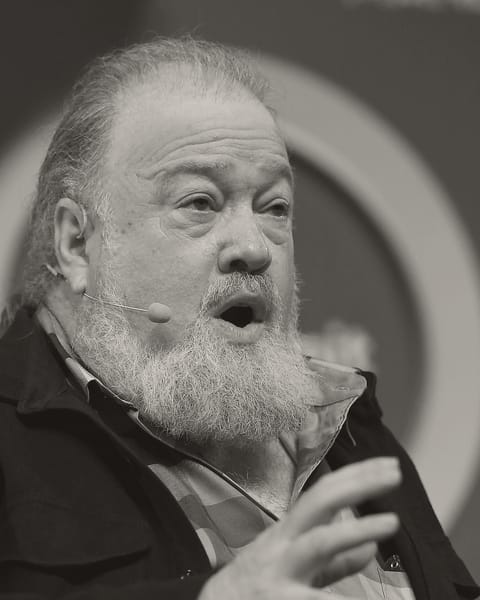


References
- University of Washington Paul G. Allen School, “New York Times: UW CSE alum Nick Szabo = Satoshi Nakamoto?”, 15 May 2015.
- Unenumerated (Nick Szabo’s blog), “New Zealander challenges Amazon one-click patent”, 20 December 2005.
- The Tim Ferriss Show (transcript), “The Quiet Master of Cryptocurrency — Nick Szabo”, 4 June 2017.
- Nick Szabo (copy hosted by the University of Amsterdam), “Smart Contracts”, 1994.
- Nick Szabo (copy hosted by the University of Amsterdam), “Smart Contracts: Building Blocks for Digital Markets”, 1996.
- ethereum.org, “Introduction to smart contracts”.
- ethereum.org, “Ethereum Whitepaper”, 2014.
- Nick Szabo (Internet Archive copy), “Trusted Third Parties are Security Holes”, 2001.
- Nick Szabo (Internet Archive copy), “Shelling Out: The Origins of Money”, 2002.
- Unenumerated (Nick Szabo’s blog), “Bitcoin, what took ye so long?”, 28 May 2011.
- Unenumerated (Nick Szabo’s blog), “Bit gold”.
- Bitcointalk, “Bitcoin and me (Hal Finney)”, 19 March 2013.
- Hal Finney’s RPOW site (Internet Archive copy), “Reusable Proofs of Work”, 16 August 2004.
- Unenumerated (Nick Szabo’s blog; Internet Archive copy), “Bit gold markets, with Szabo’s comment of 9 April 2008”, 9 April 2008.
- bitcoin.org, “Bitcoin: A Peer-to-Peer Electronic Cash System”, 31 October 2008.
- Satoshi Nakamoto Institute (Bitcointalk archive), “Re: They want to delete the Wikipedia article”, 20 July 2010.
- The New York Times (Nathaniel Popper; Internet Archive copy), “Decoding the Enigma of Satoshi Nakamoto and the Birth of Bitcoin”, 15 May 2015.
- Unenumerated (Nick Szabo’s blog), “Money, blockchains, and social scalability”, 9 February 2017.
- JAN3, “About”.
- Universidad Francisco Marroquín (New Media), “Nick Szabo”.
- Like In A Mirror (Skye Grey), “Satoshi Nakamoto is (probably) Nick Szabo”, 1 December 2013.
- TechCrunch, “Who Is The Real Satoshi Nakamoto? One Researcher May Have Found The Answer”, 5 December 2013.
- ScienceDaily (Aston University), “Likely author of original Bitcoin paper? Researchers uncover linguistic evidence”, 17 April 2014.
- IBTimes UK, “Bitcoin Creator Revealed? Satoshi Nakamoto's True Identity Unmasked”, 12 November 2014.
- Internet Archive (copy of Szabo’s “Bit gold” post, dated 29 December 2005), “Unenumerated: Bit gold, as captured on 29 March 2006”, 29 March 2006.
- Internet Archive (copy of the same post, re-dated 27 December 2008), “Unenumerated: Bit gold, as captured on 17 October 2009”, 17 October 2009.
- Internet Archive (copy of Szabo’s blog, showing “Bit gold markets” dated 9 April 2008), “Unenumerated, as captured on 18 May 2008”, 18 May 2008.
- LessWrong (Wei Dai), “Comment on “AALWA: Ask any LessWronger anything””, 17 March 2014.
- David Gerard, “No, Nick Szabo wasn’t Satoshi in 2014 either”, 16 December 2018.
- The New York Times (John Carreyrou with Dylan Freedman; Internet Archive copy), “My Quest to Solve Bitcoin’s Great Mystery”, 8 April 2026.
- Lex Fridman Podcast #252 (YouTube), “Elon Musk: SpaceX, Mars, Tesla Autopilot, Self-Driving, Robotics, and AI”, 28 December 2021.
- X (Twitter), @NickSzabo4, ““Not Satoshi, but thank you.””, 7 July 2014.
- Internet Archive (copy of the “Bit gold” post, still dated 29 December 2005), “Unenumerated: Bit gold, as captured on 9 November 2007”, 9 November 2007.