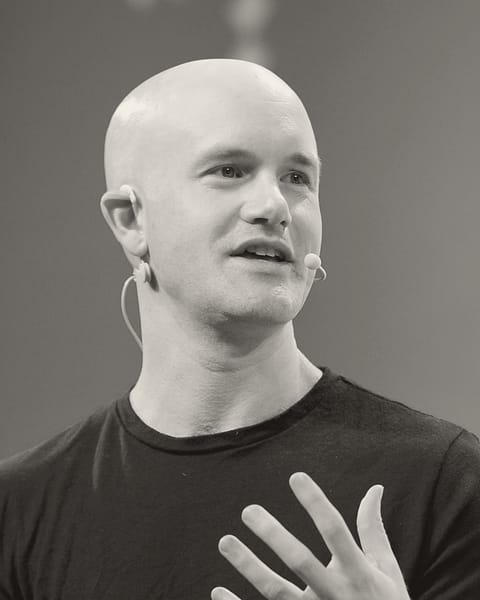
Brian Armstrong.
Co-founder and chief executive of Coinbase
Brian Armstrong built Coinbase, the app that made buying bitcoin easy for people who aren’t programmers. When he started it in 2012, buying bitcoin was, in his words, “scary unless you’re technical”; by 2020 Coinbase had 43 million users.
Before Coinbase
Armstrong had been running an online business for seven years before he found Bitcoin. He studied computer science and economics at Rice University and took a master’s degree in computer science there. From August 2003 he ran Universitytutor.com, an online directory of tutors that he founded, and in 2005 he spent a few months as a consultant at the accounting firm Deloitte. In May 2011 he joined Airbnb as a software engineer and helped build its fraud-prevention systems. Y Combinator, the start-up investor that later backed Coinbase, called that work on international payments and security “excellent context” for running Coinbase.[1][3]
He came to Bitcoin through its white paper, which he later called “a deceptively simple 9 page document by Satoshi Nakamoto”. “The Coinbase journey started when I read the Satoshi whitepaper while I was home for Thanksgiving in 2010,” he wrote on 14 April 2021, the day Coinbase became a public company. In a letter to investors that February, he said he had realised “this computer science breakthrough might be the key to unlock” a future with “more economic freedom for every person and business”: “Every payment could be as fast, cheap, and global as sending an email.”[1][2]
Read about the white paperBuilding Coinbase
He began coding an early version of Coinbase “on nights and weekends” and started going to early bitcoin meetups around the Bay Area. In March 2012 he applied to Y Combinator, saying he had already built one of the first Android apps for bitcoin as a side project. The company was called Bitbank, he wrote later, “until I learned that ‘bank’ carries a very specific legal, regulatory definition!”[2][3]
The application also set out the problem he wanted to solve: “In the bitcoin world, right now people use the open source desktop client which is scary unless you’re technical (34 digit hashes are your send/receive addresses). People also go through multi-step processes to buy and sell bitcoins through different intermediaries.” Those “hashes” were bitcoin addresses, the long strings of letters and numbers that payments are sent to.[2][3]
What a bitcoin address isY Combinator took him into its summer 2012 group. “Their $150k first check helped me believe in myself and gave me the courage to quit my job,” he wrote, and he left Airbnb in June 2012; Coinbase had been incorporated the month before. Few people shared his conviction. “It’s hard to overstate how bad of an idea everyone thought Coinbase was,” he recalled. “Friends in tech said they didn’t get it or that it was a scam.”[1][2][3][4]
He still needed a co-founder. After more than 50 meetings with possible partners (“it’s a lot like dating”, he wrote), he met Fred Ehrsam through Reddit. Ehrsam had been a foreign-exchange trader at the investment bank Goldman Sachs until June 2012. He was Coinbase’s president from November 2012 to January 2017, and he was still on its board in 2026.[1][2][4]
Coinbase started by letting customers buy and sell one crypto asset, bitcoin, and by keeping it for them: a hosted wallet that, in Y Combinator’s words, “made it easy for non-technical people to participate in this new digital currency”. Its retail users grew from about 13,000 at the end of 2012 to 43 million at the end of 2020, and by early 2021 they could invest in more than 45 crypto assets.[1][3]
A public company
On 14 April 2021 Coinbase’s shares began trading on the Nasdaq stock exchange through a direct listing: existing shareholders sold shares on the market, with no banks underwriting the sale, and Coinbase raised no money. “Today is a big moment for @coinbase as we become a public company,” Armstrong wrote. In his February letter to investors he had made trust the company’s case: “From the early days, we decided to focus on compliance, reaching out to regulators proactively to be an educational resource, and pursuing licenses even before they were needed.”[1][2][4]
By a narrower measure, customers who use it in a given month, Coinbase counted an average of about 9.2 million in 2025, its annual report said, and on 19 May that year it joined the S&P 500, the index of the largest US companies. Reuters reported that it was “the first digital asset player to be included” in the index, and called Coinbase “the largest publicly traded cryptocurrency exchange in the world”.[4][13]
Who holds a customer’s bitcoin
For an ordinary customer, buying bitcoin on Coinbase means Coinbase holds it for them, pooled with other customers’ coins, with each customer’s share kept in Coinbase’s own records. Its user agreements apply a US commercial law under which crypto it holds in the US for customers is “not property of Coinbase”, its 2025 annual report says.[4]
What a crypto exchange isThe filings also carry a warning. In May 2022 Coinbase’s quarterly report said that if the company went bankrupt, the crypto it held for customers could be treated as part of the bankruptcy, leaving customers as unsecured creditors, who are among the last to be paid. Armstrong answered that night: “Your funds are safe at Coinbase, just as they’ve always been.” He said the company had “no risk of bankruptcy” and would take further steps to protect retail customers, Reuters reported. “We should have updated our retail terms sooner, and we didn’t communicate proactively when this risk disclosure was added,” he said. “My deepest apologies.” The warning is still in Coinbase’s 2025 annual report.[4][5][6]
Coinbase holds bitcoin, too, for people who never open an account with it. BlackRock’s iShares Bitcoin Trust, for example, is an exchange-traded fund (ETF): it holds bitcoin, and its shares trade on Nasdaq. Its January 2024 prospectus names Coinbase Custody Trust Company, a Coinbase subsidiary, as the custodian of that bitcoin, responsible for “holding the private keysPrivate keyThe secret number that lets you spend your bitcoin. Whoever knows it controls the coins, so it must never be shared. that provide access to the Trust’s digital wallets and vaults”. Coinbase’s 2025 annual report says it serves as a custodian for “several Bitcoin and Ethereum ETF issuers”.[4][7]
Read about spot bitcoin ETFsThe SEC case
On 6 June 2023 the US Securities and Exchange Commission (SEC), the federal regulator of securities markets, sued Coinbase in federal court in New York. It charged Coinbase with running its trading platform as an unregistered securities exchange, broker and clearing agency. It also said Coinbase’s staking programme, which pools customers’ coins to help confirm transactions on certain blockchains and passes on part of the rewards, was an unregistered offer of securities. “Coinbase’s alleged failures deprive investors of critical protections, including rulebooks that prevent fraud and manipulation, proper disclosure, safeguards against conflicts of interest, and routine inspection by the SEC,” said its chair, Gary Gensler.[8]
The SEC named 13 tokens available through Coinbase that it said were securities, such as SOL, the token of the Solana blockchainBlockchainBitcoin's shared record of every payment since 2009, stored in blocks that each link to the one before — which is what makes it a chain., as examples rather than a full list; bitcoin was not one of them. Coinbase argued that the trades on its platform did not involve securities at all, so they fell outside the SEC’s authority. Both sides agreed, the federal judge hearing the case later wrote, that it hinged on that difference of opinion.[9]
In March 2024 that judge, Katherine Polk Failla, let most of the case go ahead. At that early stage she was weighing the SEC’s allegations, not proof, and found that they “plausibly support” its claim that Coinbase acted as an unregistered intermediary of securities, and that its staking claim was adequately made. She dismissed its claim that Coinbase Wallet, an app in which users hold their own keys, made Coinbase an unregistered broker, and in January 2025 she allowed Coinbase to ask a higher court to review her ruling.[4][9][12]
Then the SEC changed course. On 21 January 2025 its acting chairman, Mark Uyeda, set up a Crypto Task Force to help write clearer rules for crypto. On 27 February the two sides filed a joint stipulation, an agreed court filing, dismissing the case “with prejudice”, so the SEC cannot bring the same charges again, with no costs or fees for either side; Coinbase dropped its request to appeal. The SEC said the dismissal would help it “reform and renew its regulatory approach to the crypto industry”, and did not rest “on any assessment of the merits of the claims alleged in the action”.[11][12]
Armstrong had announced the agreement six days earlier, calling it “hugely vindicating, especially because many people questioned my decision to engage in litigation with the SEC on this matter in 2023”. “The SEC was wrong on the law,” he wrote: it had been “asking us to delist a number of assets that were not securities”, and “the SEC itself had allowed us to go public in 2021 after reviewing our listing standards in depth”. He gave credit to “the Trump administration, for winning the election, and for the departure of the activist head of the SEC, Gary Gensler”. He was still Coinbase’s chief executive and chairman when it filed its annual report in February 2026.[4][10]
Reviewed . To report a mistake, email hello@utxohub.com.
Picture: Brian Armstrong at TechCrunch Disrupt, 2018. TechCrunch, CC BY 2.0, toned by UTXOHub.

More people
Bitcoin in public life Michael SaylorFounder and executive chairman of Strategy (MicroStrategy)
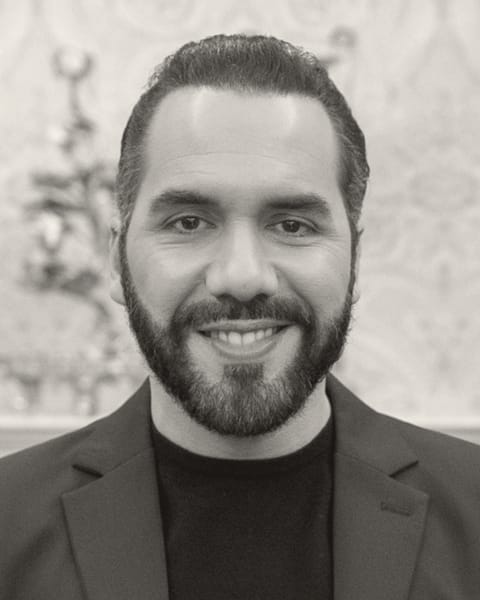 Nayib BukeleProposed El Salvador’s 2021 Bitcoin Law as president
 Ross UlbrichtCreator of Silk Road, convicted in 2015, pardoned in 2025
 Mark KarpelèsHead of Mt. Gox, the exchange that collapsed in 2014
 Roger VerEarly bitcoin investor and promoter, later of Bitcoin Cash
 Jihan WuBitmain co-founder; chairman and chief executive of Bitdeer
 Jack DorseyCo-founder of Twitter and of Block, formerly Square
 John McAfeeMcAfee antivirus founder who promoted cryptocurrencies
 Changpeng ZhaoFounder and former chief executive of Binance
References
- US Securities and Exchange Commission (Coinbase filing), “Coinbase Global, Inc. Form S-1 Registration Statement, with the founder letter”, 25 February 2021.
- X (Twitter), @brian_armstrong, “Today is a big moment for @coinbase as we become a public company… (thread)”, 14 April 2021.
- Y Combinator (Dalton Caldwell), “Coinbase from YC to IPO”, 14 April 2021.
- US Securities and Exchange Commission (Coinbase filing), “Coinbase Global, Inc. Annual Report on Form 10-K for 2025”, 12 February 2026.
- X (Twitter), @brian_armstrong, “There is some noise about a disclosure we made in our 10Q today… (thread)”, 11 May 2022.
- Reuters (via Business Standard), “Coinbase new disclosure does not mean crypto firm risks bankruptcy: CEO”, 11 May 2022.
- US Securities and Exchange Commission (iShares Bitcoin Trust filing), “iShares Bitcoin Trust prospectus (Form 424B3)”, 10 January 2024.
- US Securities and Exchange Commission, “SEC Charges Coinbase for Operating as an Unregistered Securities Exchange, Broker, and Clearing Agency”, 6 June 2023.
- US District Court for the Southern District of New York (via CourtListener), “SEC v. Coinbase, Inc., 23 Civ. 4738 (KPF): Opinion and Order”, 27 March 2024.
- X (Twitter), @brian_armstrong, “Great news! After years of litigation…”, 21 February 2025.
- US Securities and Exchange Commission, “SEC Announces Dismissal of Civil Enforcement Action Against Coinbase”, 27 February 2025.
- US District Court for the Southern District of New York (via CourtListener), “SEC v. Coinbase, Inc., 23 Civ. 4738 (KPF): Joint Stipulation to Dismiss, and Releases”, 27 February 2025.
- Reuters (via Tiger Brokers), “Coinbase shares jump on addition to S&P 500 index in watershed for crypto market”, 13 May 2025.