Jihan Wu.
Bitmain co-founder; chairman and chief executive of Bitdeer · Also known as Wu Jihan
Jihan Wu co-founded Bitmain, the biggest maker of bitcoin mining machines, and pushed for bigger blocks in the 2017 dispute that produced Bitcoin Cash. Critics suspected he was behind the split; he denied it.
Building Bitmain
Jihan Wu studied economics and psychology at Peking University, graduating in 2009, and was working in private equity when he read about Bitcoin in a blog post in 2011. One line stuck with him: “They described it as the most dangerous open-source project ever,” he told Quartz in 2017. He believed money could work without a government behind it: “It doesn’t have to be government-backed. It doesn’t even have to be gold-backed.” He put everything in. “I spent all my life savings to buy bitcoin in 2011,” he said. “Most people thought it was risky or a scam.”[1][2]
He had already met his future partner, the chip designer Micree Zhan, by chance: in 2010 one of Zhan’s staff was out looking for customers on a Beijing street when Wu walked by, and Zhan asked him for advice on raising money for his start-up. By 2013 bitcoin had caught mainstream attention, and Wu saw that he could make money by creating new bitcoin as well as trading it. For that he needed a chip designer, so he emailed Zhan everything he knew about bitcoin. “I spent two hours reading up on bitcoin on Wikipedia,” Zhan said. “I decided to do this business immediately.” They founded Bitmain that year, Wu as the business mind and Zhan as the technical one.[1][2]
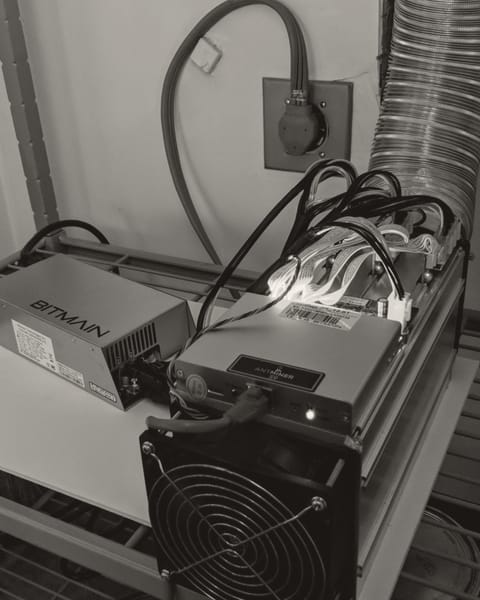
Bitmain’s product was the Antminer, a machine built for one job: Bitcoin’s mining work. Miners compete to add the next block of payments to the blockchainBlockchainBitcoin's shared record of every payment since 2009, stored in blocks that each link to the one before — which is what makes it a chain. by making guess after guess at a puzzle, and the first to find an answer is paid in new bitcoin. How many guesses a machine makes each second is its hashrateHashrateHow many guesses a second all of Bitcoin's miners make together. More hashrate makes the network harder to attack.. Zhan’s task was to design an ASICASICA machine built to do nothing but Bitcoin mining: chips that hash trillions of times a second, far beyond any ordinary computer., a chip made to do a single job extremely efficiently, that would run SHA-256, the calculation behind each guess. “He complained it was impossible,” Wu said, but Zhan went from idea to finished chip in six months. The first Antminer, the S1, went on sale in November 2013.[2]
What hashrate measuresSales took off, then slumped after Mt. Gox, once the biggest bitcoin exchange, collapsed in February 2014 and bitcoin’s price fell. “Our toughest time was at the end of 2014,” Wu said. Bitmain recovered with the Antminer S5, which used about a third less power than the S1. By 2017 Wu was Bitmain’s co-chief executive, and he said it had more than 70% of the market for bitcoin mining machines.[2][3][13]
Bitmain was more than a machine maker. It mined for itself and ran mining poolsMining poolA group of miners who share the work of finding blocks and split the rewards, so each gets paid steadily instead of rarely., where many miners combine their machines and share the rewards, and in August 2017 its pools AntPool and BTC.com had 28.9% of the network’s hashrate. That mattered because controlling hashrate gave miners what Quartz called “a public vote” on proposals to change Bitcoin. Bitmain’s hold on the machines themselves has lasted. In a 2025 survey of mining firms that together ran nearly half of Bitcoin’s hashrate, the Cambridge Centre for Alternative Finance found that Bitmain had 82% of the market among them, weighted by each firm’s hashrate, a concentration that it said “has long been a topic of debate, raising questions about market power”.[2][4]
See AntPool’s recent blocksThe block-size dispute
By 2017 Bitcoin users were divided over how to fit in more payments. Blocks were capped at 1 MB, and Wu was a vocal supporter of removing the cap, Quartz reported. Others, including Gregory Maxwell and Pieter Wuille, two developers of the Bitcoin software known as Bitcoin Core, backed SegWitSegWitSegregated Witness: a 2017 upgrade that moved signatures into a separate part of each payment, making room for more payments. instead: a soft fork, meaning a change older software still accepts, that made room for more payments. Raising the cap needed a hard fork, which older software rejects. Maxwell had set out the worry about bigger blocks in 2015: that if Bitcoin became too costly to check for yourself, “people will be forced to trust third parties rather than independently enforcing the system’s rules”. But SegWit could switch on only once enough miners signalled support, and in May 2017, according to the organisers of SegWit2x, a compromise launched that month, only 30% did.[2][5][6][7]
Bitmain said it had supported SegWit, but only alongside bigger blocks, as set out in the Hong Kong Agreement of February 2016, until, it wrote in April 2017, “we no longer felt that it was going to happen in the foreseeable future”. In June it answered the cost argument head on: “We do not believe that decentralization means a 1MB block size limit or a responsibility to constrain the block size so that a Raspberry Pi can run a full node while the fee per Bitcoin transaction is higher than the daily income in most developing countries.” A Raspberry Pi is a small, cheap computer, and a full node is software that checks every block.[3][6]
Maxwell went further in April 2017, with a warning about mining chips. He wrote that ASICBoost, a patented shortcut in the mining calculation, could cut a miner’s energy costs by up to 30%, and that a hidden way of using it could block improvements such as SegWit. Reverse engineering of a mining chip “from a major manufacture” had found an undisclosed ability to use it. Such an incompatibility, he argued, “would go a long way to explain some of the more inexplicable behavior from some parties in the mining ecosystem”, and exploiting it could have “a phenomenal centralizing effect” by making mining unprofitable for everyone else. He named no company.[8]
Bitmain, which said it held the ASICBoost patent in China, replied two days later that the claim “seems directed towards Bitmain”. Its chips, “like those of some other manufacturers”, could support ASICBoost, it said, but it “has never used ASICBOOST on the mainnet”, Bitcoin’s real network. It called the method “an engineering optimization”, not an attack, and said the bigger blocks it wanted would make the shortcut harder to use: “The conspiracy theories do not add up here.”[3]
In May 2017 Bitmain joined the New York Agreement, a deal among mining and industry firms whose plan, known as SegWit2x, was to switch on SegWit and then double the block size. The firms behind it, Bitmain wrote, had “more than 80% of the entire hashing power”.[2][6][7]
Critics saw a miner trying to set Bitcoin’s rules. Some regarded the New York Agreement’s plan as “technically risky, and philosophically fraught because it concentrates power in the hands of miners—like Bitmain”, Quartz reported.[2]
Bitcoin Cash
Other users wanted to force SegWit through without the miners. Under a proposal called BIP148, their nodes would reject any block that didn’t signal support for SegWit from 1 August. Bitmain called that a threat, and on 14 June it published a contingency plan: if BIP148 split the network, it would mine a separate chain allowing blocks over 1 MB. It called this a “User Activated Hard ForkHard forkA change that loosens Bitcoin's rules, so nodes running old software reject the new blocks. Without near-universal agreement it splits the chain.”, and “a peaceful and voluntary departure”. Wu said such splits shouldn’t be avoided. Bitcoin, he told Quartz, “is not software, it is a kind of social agreement that is implemented by software. And if people do not agree with each other, a fork will be inevitable.”[2][6]
What BIP-148 doesOthers took up Bitmain’s plan. On 24 July Bitmain said that a planned fork called Bitcoin Cash was based on its contingency plan, but led by developers who wanted bigger blocks, whose opinions it “cannot and does not control”. It did not rule out supporting Bitcoin Cash too. Bitcoin Cash split from Bitcoin in August 2017, backed by ViaBTC, a mining firm Bitmain had invested in, and critics suspected Wu was behind it. He denied it. “If we had such an influence,” he told Quartz, Bitcoin Unlimited, an earlier big-block plan he had backed, “would have already been activated.”[2][9][10]
The last block before Bitcoin Cash split offIn the end Bitcoin got SegWit without the bigger blocks. SegWit switched on that August, and on 8 November SegWit2x’s organisers, Wu among them, called off the 2 MB increase: “Although we strongly believe in the need for a larger blocksize, there is something we believe is even more important: keeping the community together.” Bitcoin Cash carried on as a separate coin. In 2018 The Wall Street Journal reported that it was one of Bitmain’s biggest holdings, and that Wu backed it, believing it would fix problems such as slow transactions.[7][10]
The block where SegWit took effectThe split with Micree Zhan
Bitmain’s next fight was inside the company. In 2018 it applied to list its shares in Hong Kong. The application lapsed in 2019, and both co-founders stepped down as co-chief executives, the Chinese tech news site TechNode reported. Wu also appeared to step back after a falling-out with Zhan over Bitmain’s artificial-intelligence chips, a business Zhan had led.[2][10][11]
In October 2019 Wu came back. In an email to all staff, as Bitmain’s “co-founder, chairman, legal representative, and executive director”, he dismissed Zhan “from all his roles in the company, effective immediately”, and warned that staff who kept taking Zhan’s orders could lose their jobs, in TechNode’s translation. Zhan was the larger shareholder: Bitmain’s Hong Kong application had shown him owning 36% of the company and Wu 20%.[11]
The struggle lasted more than a year. It ended with a settlement in January 2021, which Wu announced in a letter released in code and decoded by the crypto news site The Block. Zhan bought almost half the shares held by Wu and a group of other founding shareholders, and Wu said he had resigned as Bitmain’s chief executive and chairman. He called the settlement “amicable” and “constructive”. “As the co-founder of Bitmain, I enjoyed the 2,815 days of journey working for it,” he wrote, giving “my most sincere blessing to Bitmain and its leadership of Micree”.[1][12]
Bitdeer
Wu left with part of the business. Bitdeer, which mines bitcoin, rents out mining power and runs other people’s machines, was separated from Bitmain on 26 January 2021 under the settlement, with Wu as chairman. It listed on Nasdaq in April 2023, and he became its chief executive in March 2024. It runs data centres from the United States to Bhutan and Ethiopia, and is turning some of them over to AI computing.[1][12]
Bitdeer has also gone back to where Bitmain began. It designs its own mining chips and machines, called SEALMINER, and began selling them in 2025; the Cambridge report counted it among the new chip makers “gaining traction”. Wu is also a co-founder and the chairman of BIT Group, a crypto lending and custody firm called Matrixport until March 2026, where he has been a director since 2019.[1][4]
Reviewed . To report a mistake, email hello@utxohub.com.
Picture: An Antminer, the Bitcoin mining machine made by Bitmain, the company Jihan Wu co-founded. Steve Rainwater, CC BY-SA 2.0, toned by UTXOHub.

More people
Bitcoin in public life Michael SaylorFounder and executive chairman of Strategy (MicroStrategy)
 Nayib BukeleProposed El Salvador’s 2021 Bitcoin Law as president
 Ross UlbrichtCreator of Silk Road, convicted in 2015, pardoned in 2025
 Mark KarpelèsHead of Mt. Gox, the exchange that collapsed in 2014
 Roger VerEarly bitcoin investor and promoter, later of Bitcoin Cash
 Brian ArmstrongCo-founder and chief executive of Coinbase
 Jack DorseyCo-founder of Twitter and of Block, formerly Square
 John McAfeeMcAfee antivirus founder who promoted cryptocurrencies
 Changpeng ZhaoFounder and former chief executive of Binance
References
- US Securities and Exchange Commission (Bitdeer filing), “Bitdeer Technologies Group Annual Report on Form 20-F for 2025”, 30 April 2026.
- Quartz (archived), “China’s Bitmain dominates bitcoin mining. Now it wants to cash in on artificial intelligence”, 20 August 2017.
- Bitmain blog (archived), “Regarding Recent Allegations and Smear Campaigns”, 7 April 2017.
- Cambridge Centre for Alternative Finance, “Cambridge Digital Mining Industry Report: Global Operations, Sentiment, and Energy Use”, April 2025.
- bitcoin-dev mailing list (archived), “Capacity increases for the Bitcoin system (Gregory Maxwell)”, 7 December 2015.
- Bitmain blog (archived), “UAHF: A contingency plan against UASF (BIP148)”, 14 June 2017.
- Bitcoin-segwit2x mailing list (archived), “Segwit2x Final Steps (Mike Belshe, Wences Casares, Jihan Wu, Jeff Garzik, Peter Smith and Erik Voorhees)”, 8 November 2017.
- bitcoin-dev mailing list (archived), “BIP proposal: Inhibiting a covert attack on the Bitcoin POW function (Gregory Maxwell)”, 5 April 2017.
- Bitmain blog (archived), “Regarding “Bitcoin Cash”, ViaBTC and Bitcoin ABC”, 24 July 2017.
- The Wall Street Journal (reprinted by La República), “Crypto Meets Wall Street as Bitcoin Mining Giant Bitmain Files for IPO”, 1 October 2018.
- TechNode, “Bitmain’s Wu Jihan ousts co-founder in dramatic comeback”, 30 October 2019.
- The Block, “Jihan Wu writes in coded letter that he’s officially stepping down as Bitmain chairman”, 26 January 2021.
- MtGox Co., Ltd., “Announcement regarding an application for commencement of a procedure of civil rehabilitation”, 28 February 2014.