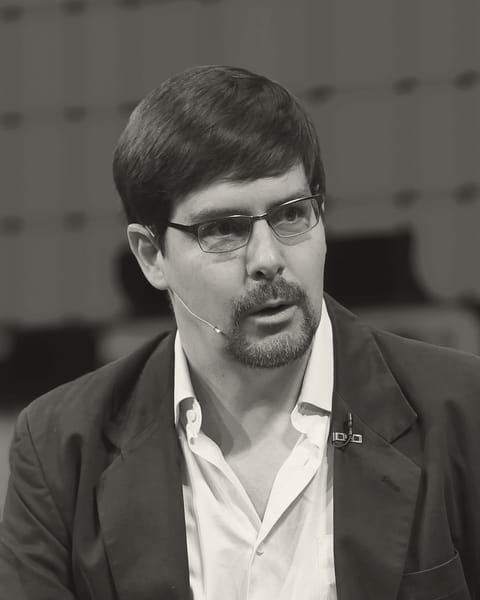
Gavin Andresen.
Lead Bitcoin developer after Satoshi, 2010–2014
Gavin Andresen is a software engineer whom Satoshi Nakamoto chose to run Bitcoin’s software in late 2010. He led its development until 2014, wrote BIP-16, the upgrade behind addresses that start with 3, and later pushed to raise the limit on the size of blocks. In 2016 he said he believed Craig Wright was Satoshi, a judgement he later called a mistake.
Before Bitcoin
Andresen was born Gavin Bell in Melbourne, Australia, and moved to the United States when he was five. He studied computer science at Princeton, graduating in 1988, and spent eight years at Silicon Graphics working on 3D graphics, where by his own account he was the chief architect of VRML97, a standard for showing 3D scenes on the web. Later he was chief technology officer of a company making online games that blind and sighted people could play together. In 2000 he took his mother’s maiden name, Andresen.[8][10][11][9]
Finding Bitcoin
He first read about Bitcoin in an InfoWorld article in May 2010. A month later he wrote on his blog: “Bitcoin is a new kind of money that fixes a bunch of bugs in the old-fashioned money.” He added: “Maybe I am crazy. What percentage of crazy people think they’re sane?” He bought about 10,000 bitcoins for $50, Wired later reported.[8][13][12]
Then he started giving bitcoins away. On 11 June 2010 he announced the Bitcoin Faucet, a project that he admitted “sounds really dumb”: a website that handed out five bitcoins to each visitor, so that newcomers could “get a handful of coins to try it out”. He stocked it with 1,100 to start and cut the handout as people came back again and again. In March 2012 an intruder got into the systems of Linode, the company that hosted the Faucet, and broke into eight bitcoin-related accounts: the Faucet lost the five bitcoins in its wallet, Andresen wrote, and Marek Palatinus’s mining poolMining poolA group of miners who share the work of finding blocks and split the rewards, so each gets paid steadily instead of rarely. lost 3,094. The Faucet closed later that year after repeated attempts at fraud; by his own count it gave away more than 10,000 bitcoins. He also proposed Testnet, a separate network where developers could experiment without risking real coins, which Satoshi called “a really good idea of yours”.[1][35][36][8][14][7]
Taking over from Satoshi
In late 2010 Satoshi chose Andresen as a successor, MIT Technology Review reported. On 19 December he wrote on the Bitcoin forum: “With Satoshi’s blessing, and with great reluctance, I’m going to start doing more active project management for bitcoin.” It was, he admitted, “the first open source project of any size I’ve been involved with”. He moved the code to GitHub, where developers would propose changes as pull requests to be discussed before they were added. The developer Mike Hearn later wrote that “Satoshi never actually asked Gavin if he wanted the job, and in fact he didn’t.”[3][2][15]
In April 2011 Forbes quoted Andresen calling Bitcoin “better gold than gold”. Days later Satoshi wrote to him: “I wish you wouldn’t keep talking about me as a mysterious shadowy figure.” The email, which Andresen published in 2022, ended “I’ve moved on to other things and will probably be unavailable”, and passed on the key used to send alerts across the network. Andresen’s reply mentioned that he had been invited to speak at the CIA. It was his last exchange with Satoshi.[16][17]
He announced the visit on the forum the next day, “because it is the kind of thing that will generate conspiracy theories”, and gave the talk at the CIA’s headquarters that June. It did generate them: people still ask whether the visit drove Satoshi away, though CryptoSlate called the link “speculative at best”, since Satoshi’s farewell came first.[18][12][19]
Leading Bitcoin
As lead developer Andresen wrote BIP-16, pay to script hash, in early 2012. It let the person receiving bitcoin set the rules for spending it, such as needing two signatures out of three, while the sender only had to pay to a short address; these are the addresses that start with 3. He wanted to “stop playing whack-a-mole with wallet stealing viruses and trojans”. The change was contested, and Luke Dashjr proposed an alternative, but it switched on in April 2012 after miners signalled their support in the blocks they mined.[20][21][22]
What BIP-16 doesIn September 2012 he announced the Bitcoin Foundation, a non-profit “modeled on the Linux Foundation”, and became its chief scientist. According to Pieter Wuille’s evidence in a 2024 court case, he also suggested the name “Bitcoin Core” for the main software. On 7 April 2014 he handed the job of maintaining it to Mara van der Laan, then known as Wladimir van der Laan, whom he had yet to meet in person. “To be clear: I’m not going to disappear,” he wrote. In 2015 he moved to the Digital Currency Initiative at MIT.[23][7][4][24]
The block size fight
Each block can hold only so many payments, and from 2014 Andresen argued that the limit, then 1 megabyte, had to rise as Bitcoin grew. In 2015 he proposed 20 megabytes, reasoning that the traffic, “170 gigabytes per month”, would still fit within a home internet plan. After miners objected he settled on 8 megabytes, doubling every two years, in BIP-101. Without agreement from Bitcoin Core’s other developers, he and Mike Hearn released it in August 2015 in their own version of the software, Bitcoin XT, set to switch on if three quarters of miners backed it. They never did.[25][26][27][28]
What BIP-101 doesIn early 2016 he backed Bitcoin Classic, a smaller rise to 2 megabytes, which also failed. “Bitcoin will survive without a short-term solution,” he wrote, “but adoption and growth might be set back a year or two.” In August 2017 Bitcoin Cash split off from Bitcoin with much larger blocks. Andresen told Ars Technica: “Bitcoin Cash is what I started working on in 2010.”[29][30]
Craig Wright
In April 2016 Andresen flew overnight to London to meet Craig Wright, an Australian computer scientist who claimed to be Satoshi. In a hotel room Wright appeared to sign a message, “Gavin’s favourite number is 11 – CSW”, with a key only Satoshi should hold. On 2 May Andresen wrote that he was “convinced beyond a reasonable doubt: Craig Wright is Satoshi”. Other experts doubted the evidence Wright published that day. Bitcoin Core’s maintainers removed Andresen’s access to the project, at first fearing his account had been hacked; van der Laan wrote that he “hadn’t done anything as a maintainer for a year or so”.[7][5][6][31]
By November 2016 he had changed his tone: “I regret ever getting involved in the ‘who was Satoshi’ game.” In 2023 he added a note to his post: “I now know it was a mistake to trust Craig Wright as much as I did.” The next year the High Court in London declared that Wright is not Satoshi, and the judge found that Andresen “was initially persuaded by the signing session he attended, but later came to believe that it could well have been spoofed”.[32][5][7]
Since then
Andresen left the Bitcoin Foundation and MIT early in 2017 and has kept out of the news since. “I’ve been avoiding getting myself into any press lately,” he told CoinDesk that May. In October 2025 he launched RiskiPedia, a website about risks, writing: “I’m retired from all things crypto.”[33][34]
Reviewed . To report a mistake, email hello@utxohub.com.
Picture: Gavin Andresen at Web Summit in Dublin, 2014. Stephen McCarthy, Sportsfile for Web Summit, CC BY 2.0, toned by UTXOHub.

BIPs by Gavin Andresen
12 proposals- BIP-11M-of-N Standard Transactions
- BIP-12OP_EVAL
- BIP-13Address Format for pay-to-script-hash
- BIP-16Pay to Script Hash
- BIP-34Block v2, Height in Coinbase
- BIP-50March 2013 Chain Fork Post-Mortem
- BIP-61Reject P2P message
- BIP-70Payment Protocol
- BIP-71Payment Protocol MIME types
- BIP-72bitcoin: uri extensions for Payment Protocol
- BIP-101Increase maximum block size
- BIP-109Two million byte size limit with sigop and sighash limits
More people
The first years Satoshi NakamotoPseudonymous creator of Bitcoin
 Hal FinneyCryptographer who received the first bitcoin transaction
 Laszlo HanyeczEarly developer who paid 10,000 BTC for two pizzas
 Marek PalatinusFounder of Slush Pool and co-founder of SatoshiLabs
 Jed McCalebFounder of Mt. Gox; later co-founded Ripple and Stellar
 Mike HearnEmailed Satoshi, wrote bitcoinj, launched Bitcoin XT
 Charlie ShremCo-founder of BitInstant; Bitcoin Foundation vice chairman
References
- Bitcointalk, “Get 5 free bitcoins from freebitcoins.appspot.com”, 11 June 2010.
- Bitcointalk, “Development process straw-man”, 19 December 2010.
- MIT Technology Review, “The Man Who Really Built Bitcoin”, 15 August 2014.
- The Bitcoin Foundation (archived), “Bitcoin Core Maintainer: Wladimir van der Laan”, 7 April 2014.
- Gavin Andresen’s blog (archived), “Satoshi”, 2 May 2016.
- PBS NewsHour, “Alleged Bitcoin creator comes forward, but questions remain”, 2 May 2016.
- High Court of England and Wales (The National Archives), “Crypto Open Patent Alliance v Craig Steven Wright [2024] EWHC 1198 (Ch)”, 20 May 2024.
- Reddit, r/Bitcoin (Gavin Andresen’s AMA), “I'm Gavin Andresen, Chief Scientist at the Bitcoin Foundation. Ask me anything!”, 21 October 2014.
- Gavin Andresen’s home page (archived), “Why Andresen?”.
- Gavin Andresen’s home page (archived), “Résumé”, 2005.
- Gavin Andresen’s home page (archived), “Gavin Andresen”, 2002.
- Wired (Benjamin Wallace), “The Rise and Fall of Bitcoin”, 23 November 2011.
- Gavin Andresen’s blog, “Money, Fixed”, 26 June 2010.
- Electronic Frontier Foundation, “Thank You, Bitcoin Community”, 31 May 2013.
- Mike Hearn (archived), “The resolution of the Bitcoin experiment”, 14 January 2016.
- Forbes (Andy Greenberg), “Crypto Currency”, 20 April 2011.
- Gavin Andresen’s blog (archived), “Eleven years ago today…”, 26 April 2022.
- Bitcointalk, “Gavin will visit the CIA”, 27 April 2011.
- CryptoSlate, “Was the CIA behind Bitcoin creator Satoshi Nakamoto’s disappearance?”, 29 April 2022.
- Bitcoin Improvement Proposals, “BIP-16: Pay to Script Hash”, 3 January 2012.
- Bitcoin Improvement Proposals, “BIP-13: Address Format for pay-to-script-hash”.
- Gavin Andresen’s forum posts (Jorge Stolfi’s archive), “Re: Pay to Script Hash”, 13 January 2012.
- Bitcointalk, “[ANN] Bitcoin Foundation”, 27 September 2012.
- Bitcoin Magazine, “Gavin Andresen, Core Developers Join MIT’s Digital Currency Initiative”, 22 April 2015.
- The Bitcoin Foundation (archived), “A Scalability Roadmap”, 14 October 2014.
- Gavin Andresen’s blog (archived), “Does more transactions necessarily mean more centralized?”, 5 May 2015.
- Bitcoin Improvement Proposals, “BIP-101: Increase maximum block size”, 22 June 2015.
- Mike Hearn (archived), “Why is Bitcoin forking?”, 15 August 2015.
- Gavin Andresen’s blog (archived), “Classic? Unlimited? XT? Core?”, 13 January 2016.
- Ars Technica (Timothy B. Lee), “Bitcoin rival doubles in price in four days as bitcoin price slumps”, 12 November 2017.
- Wladimir J. van der Laan’s blog, “Dazed and confused, but trying to continue”, 6 May 2016.
- Gavin Andresen’s blog (archived), “Either/or : ignore!”, 16 November 2016.
- CoinDesk (archived), “Where Is Gavin Andresen? The Quiet Exile of Bitcoin's Former Face”, 19 May 2017.
- RiskiPedia (Gavin Andresen’s blog), “RiskiPedia announcement”, 16 October 2025.
- Bitcointalk (archived copy), “Hacked Linode & coins stolen to 1NRy8GbX56MymBhDYMyqsNKwW9VupqKVG7”, 1 March 2012.
- The Register (John Leyden), “Linode hackers escape with $70K in daring bitcoin heist”, 2 March 2012.