
Gregory Maxwell.
Bitcoin developer, co-founder of Blockstream · Also known as Greg Maxwell, gmaxwell, nullc
Gregory Maxwell laughed when Bitcoin appeared, sure he had already proven it impossible. He went on to invent CoinJoin, propose Taproot and write the plan Bitcoin Core followed through the block size fight.
Before Bitcoin
Gregory Maxwell is an American software engineer. He spent eight years at Juniper Networks “deploying some of the largest networks in the world” and several more at Mozilla, and helped build free audio formats: “I am one of the developers for the Vorbis format and the Opus format,” he said in a 2015 talk. He wanted to take on a “zillion dollar industry of codec licensing that inhibits people from publishing on the internet”.[1][2]
He was also an early Wikipedia volunteer, “involved very early in the creation of Wikipedia and system administration for it”, and an administrator of Wikimedia Commons, its library of free media, for most of the years from 2006 to 2014. He knew the work of Hal Finney, the cryptographer who later received Bitcoin’s first payment: “I was an early user of Hal’s RPOW system,” the digital tokens Finney launched in 2004.[2][3][4]
When Satoshi Nakamoto announced Bitcoin on the cryptography mailing list in 2008, Maxwell was reading. “When it happened, I sort of laughed,” he told CoinDesk. “Because I had already proven that decentralized consensus was impossible”: that strangers on the internet could never agree on one record without someone in charge. A year later he was surprised to find it still running. He read its code, “only about 3k lines”, and changed his mind: “It could radically change the face of finance in the world.”[5][2]
Privacy
Maxwell began contributing to Bitcoin’s software in 2011, and in 2012 he was given commit access, the right to merge changes into its code. Much of his own work was on privacy. Every Bitcoin payment is public, and people analysing the blockchainBlockchainBitcoin's shared record of every payment since 2009, stored in blocks that each link to the one before — which is what makes it a chain. tend to assume that coins spent together belong to one person. In January 2013 he mocked that idea in a forum thread with a joke title, “I taint rich!”, offering to sign joint payments with strangers to fulfil “a dream of being incorrectly assessed as impossibly rich by brain-dead automated analysis.”[1][2][6]
That August he set the idea out properly on BitcointalkBitcointalkThe Bitcoin forum Satoshi Nakamoto opened in November 2009. Much of Bitcoin’s early history, from the pizza offer to Satoshi’s last post, happened there., the Bitcoin forum, as CoinJoinCoinJoinA payment made together by several people, which breaks the easy link between their old and new addresses. Nobody gives up their coins.. Several people combine their payments into one transaction, so that an outsider can’t tell whose coins went where, and because “no one will sign a transaction which is not to their liking”, there is “No risk of theft at any point.” It needed no change to Bitcoin’s rules. Privacy was ordinary, he argued: with a bank, “Your inlaws don’t see that you’re buying birth control that deprives them of grand children”. He expected whoever built CoinJoin to be accused of enabling crime, and “Being a Bitcoin core developer already fills my quota for accusations of this kind”, so he offered a bounty to whoever did. CoinJoin went on to be used in several mixing services and other privacy projects, the Human Rights Foundation says.[7][1]
Payment amounts came next. Building on an idea Adam Back, the inventor of hashcash, had posted in 2013, Maxwell designed Confidential Transactions, which keep “the amounts transferred visible only to participants in the transaction (and those they designate).” “Since publishing often requires spending money, lack of privacy can chill free speech,” he wrote. It appeared in June 2015 in Elements, open-source software for sidechainsSidechainA separate blockchain that bitcoin can move to and back from, trading Bitcoin's rules for different features or speed., separate blockchains linked to Bitcoin.[8][9][10]
Blockstream and the block size fight
Elements came from Blockstream, a company Maxwell co-founded in 2014 with Back, Wuille and eight others, and where he was chief technology officer; that November it raised its first funding from venture investors. Maxwell said he and Wuille had written a safeguard into their contracts: if they felt Blockstream was acting unethically they could leave, and it would “continue to pay most of our salary for a year for us to continue working on Bitcoin core.”[9][11][12]
By 2015 Bitcoin’s developers were split over the 1 MB limit on the size of each block. On 7 December Maxwell set out a plan on the developers’ mailing list. “With the available technology, there are fundamental trade-offs between scale and decentralization,” he wrote. “If the system is too costly people will be forced to trust third parties rather than independently enforcing the system’s rules.” Instead of a hard forkHard forkA change that loosens Bitcoin's rules, so nodes running old software reject the new blocks. Without near-universal agreement it splits the chain. to raise the limit, a change older software rejects, he backed Segregated WitnessSegWitSegregated Witness: a 2017 upgrade that moved signatures into a separate part of each payment, making room for more payments., or SegWit, which Wuille had just presented and which could be added as a soft forkSoft forkA change that tightens Bitcoin's rules, so nodes that haven't upgraded still accept the new blocks., a change older software still accepts: “I propose we work immediately towards the segwit 4MB block soft-fork”. Developers who had written more than 90% of the year’s changes to Bitcoin Core signed a statement supporting the plan.[13][14]
His opponents saw the plan differently. Mike Hearn, who had released a rival version of the software, Bitcoin XT, with Gavin Andresen, Bitcoin’s lead developer after Satoshi, to raise the limit, wrote in January 2016 that Maxwell “did not believe in Satoshi’s original vision”. After Maxwell’s company hired other developers, Hearn argued, “their views then started to change to align with that of their new boss.” The New York Times reported that Maxwell and Mara van der Laan, Bitcoin Core’s lead maintainer, had seen XT “as an act of betrayal”, and that Maxwell “appears to have pulled back from his work on Bitcoin after receiving anonymous death threats.”[15][16]
Maxwell rejected the idea that a company ran Bitcoin. On 16 December 2015, nine days after his plan, he gave up his commit access “of my own accord”, he wrote later, partly “because of toxic mistaken beliefs”. “Blockstream doesn’t run Core,” he wrote in January 2016. Asked whether Bitcoin Core’s developers had a boss, he replied: “Mike Hearn’s rants would have you believe it was me.”[17][18][19][20]
The fight dragged on into 2017. That April Maxwell warned that a mining chip had been found to use ASICBoost, a patented shortcut in the mining calculation, in a hidden way that could block upgrades such as SegWit. Bitmain, the mining-machine maker co-run by Jihan Wu, said it “has tested ASICBOOST on the Testnet but has never used ASICBOOST on the mainnet”, and accused him of having led “the coup against Gavin Andresen”, whose access to Bitcoin Core had been removed in 2016. Maxwell had given up his own access months before that; van der Laan wrote that the maintainers had decided it. SegWit took effect at block 481,824 on 24 August 2017.[21][22][23][24]
See block 481,824, where SegWit took effectTaproot
Maxwell resigned from Blockstream at the end of 2017; the company said on 19 January 2018 that he had left to work on Bitcoin, “especially improved cryptography, protocols and other privacy and security technologies.” Four days later he posted an idea that had come up over lunch at a diner in Los Altos, California, with Wuille and Andrew Poelstra, Blockstream’s director of research. As another developer, Mark Friedenbach, and others had pointed out, a Bitcoin contract usually has one simple outcome, in which everyone involved signs; its other branches “would only be used where some participant is failing to cooperate”. His design, “which I call TaprootTaprootA 2021 upgrade that added Schnorr signatures and addresses starting bc1p, making complex payments cheaper and more private.”, made that common case look like an ordinary payment, so that “no one can tell that the contract alternative exists.”[25][26][27][28]
Wuille and others turned the idea into Bitcoin’s rules, and Taproot took effect at block 709,632 on 14 November 2021. It brought Schnorr signaturesSchnorr signatureA kind of digital signature Bitcoin added with Taproot in 2021. Several people can combine keys so their joint signature looks like one person's., which let several people combine their keys into one; Maxwell, the Human Rights Foundation says, had “led research into implementing Schnorr signatures in Bitcoin”. With Wuille he also designed bech32, the format of addresses that begin “bc1”.[29][1][30]
What was the Taproot upgrade?Craig Wright
Maxwell was among the first to question Craig Wright, an Australian computer scientist whom Wired and Gizmodo named in December 2015 as possibly being Satoshi. The next day Maxwell wrote that a PGP key, a digital signing key, said to link Wright to Satoshi “was clearly backdated”, and Motherboard reported his findings. When Wright publicly claimed to be Satoshi in May 2016, Maxwell wrote of “a long trail of fairly unambiguous fraud connected with his claims”. Had Wright come to him, he said, his rule would have been “Proof before sales-pitch.”[31][32][33][34]
Wright answered with lawsuits. In 2021 his company Tulip Trading sued Maxwell and other Bitcoin developers in London, arguing that they owed it a duty to write code returning bitcoins it said had been taken in a hack; Maxwell called it “a vexatious lawsuit”. In 2022 Wright sued many of them again, claiming copyright in the Bitcoin white paper and rights in the blockchain. The Human Rights Foundation says Maxwell spent “significant time and effort” defending developers who were “being harassed through frivolous but expensive lawsuits”. After the High Court ruled in 2024 that Wright is not Satoshi, both claims ended in the developers’ favour, and the judge certified them as totally without merit.[35][36][37][1][38][39]
Retirement and the argument over data
By 2021 Maxwell called himself “a retired former bitcoin developer”; his last change to Bitcoin Core’s code dates from 2019. In January 2025 he and Wuille shared the Human Rights Foundation’s Finney Freedom Prize for their work in Bitcoin’s 2012–2016 era. The foundation called him “one of the most — and perhaps the most — influential developers in Bitcoin’s short history”.[40][41][42][1]
He came back to argue in 2025, when Bitcoin Core’s developers debated lifting a limit on OP_RETURNOP_RETURNA payment output that stores data instead of paying someone. It can never be spent, so nodes don't track it as spendable. outputs, the part of a transaction meant for carrying a little data. Luke Dashjr, another long-time developer, called the idea “utter insanity”. Maxwell backed it. “Relay rules should admit all transactions which are reliably being mined,” he wrote, and “Admitting the transactions is not endorsing them, it’s just a recognition of reality.” Some years earlier, he recalled, defending the limit had brought him “threats of physical violence”; but such limits “aren’t holy, they’re a hack”. Bitcoin Core 30.0 effectively lifted it in October 2025.[43][44][45][46]
The argument then moved to Bitcoin’s rules. BIP-110, a proposal whose original draft came from Dashjr, set out to write limits on data into Bitcoin’s rules for a year, arguing that data embedding “must be resisted at all times”. Maxwell said it imposed controls on everyone: “A spam filter is something you consent to and you control and only impacts you,” he wrote, whereas “Bip110 is about imposing controls on OTHER people.” “The price of freedom is eternal vigilance and all that,” he added, “but damn, the reality of it kinda sucks.” When block 961,632 was mined on 8 August 2026, the nodes enforcing BIP-110 split off onto a chain of their own.[47][48][49]
See block 961,632, where the chains splitReviewed . To report a mistake, email hello@utxohub.com.
Picture: Gregory Maxwell speaking at SF Bitcoin Devs, 2015. SF Bitcoin Developers, CC BY 3.0, toned by UTXOHub.
BIPs by Gregory Maxwell
2 proposalsMore people
Building Bitcoin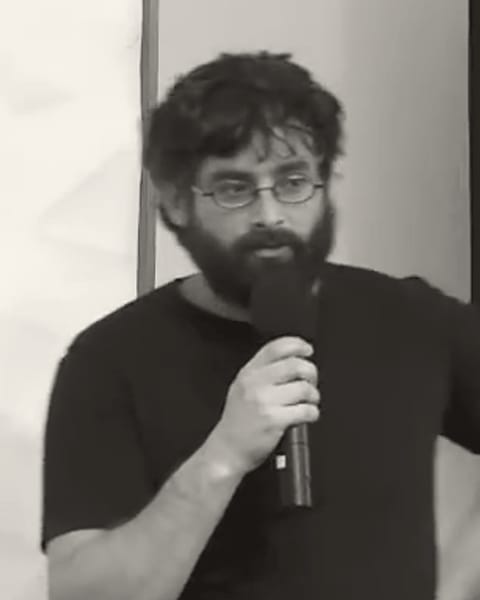 Pieter WuilleBitcoin Core developer, co-author of SegWit and Taproot
 Mara van der LaanLead maintainer of Bitcoin Core, 2014–2022
 Andreas M. AntonopoulosAuthor of Mastering Bitcoin
 Elizabeth StarkCo-founder and CEO of Lightning Labs
 Peter ToddBitcoin developer behind replace-by-fee and OpenTimestamps
 Luke DashjrMaintainer of Bitcoin Knots, BIP editor 2016–2026
References
- Human Rights Foundation (archived), “About Peter Wuille and Gregory Maxwell”.
- SF Bitcoin Devs, transcript by Bryan Bishop, “Bitcoin Selection Cryptography (Gregory Maxwell)”, April 2015.
- Wikimedia Commons, “User rights log: User:Gmaxwell”.
- Cryptography mailing list (Hal Finney), “RPOW - Reusable Proofs of Work”, 15 August 2004.
- CoinDesk (Daniel Cawrey), “Gregory Maxwell: How I Went From Bitcoin Skeptic to Core Developer”, 29 December 2014.
- Bitcointalk (archived), “I taint rich! (Raw txn fun and disrupting ‘taint’ analysis; >51kBTC linked!)”, 28 January 2013.
- Bitcointalk (archived), “CoinJoin: Bitcoin privacy for the real world”, 22 August 2013.
- Gregory Maxwell (archived), “Confidential Transactions”, 2015.
- Blockstream (Austin Hill; archived), “Blockstream closes $21M seed round”, 17 November 2014.
- Blockstream (Adam Back; archived), “Announcing Sidechain Elements: Open source code and developer sidechains for advancing Bitcoin”, 8 June 2015.
- Blockstream (archived), “Team”, February 2015.
- Reddit, u/nullc (Gregory Maxwell), “Comment in the r/IAmA session with the sidechains paper’s authors”, 23 October 2014.
- Bitcoin development mailing list (Gregory Maxwell), “Capacity increases for the Bitcoin system”, 7 December 2015.
- Bitcoin.org, “Capacity increases FAQ”, December 2015.
- Mike Hearn (archived), “The resolution of the Bitcoin experiment”, 14 January 2016.
- The New York Times (Nathaniel Popper; archived), “A Bitcoin Believer’s Crisis of Faith”, 14 January 2016.
- Reddit, u/nullc (Gregory Maxwell), “On removing his commit access in December 2015”, 1 October 2016.
- Reddit, u/nullc (Gregory Maxwell), “On dropping commit access”, 11 December 2019.
- Reddit, u/nullc (Gregory Maxwell), “Replies to Mike Hearn’s essay”, 17 January 2016.
- Reddit, u/nullc (Gregory Maxwell), “Reply to Mike Hearn’s essay”, 17 January 2016.
- Bitcoin development mailing list (Gregory Maxwell; archived), “BIP proposal: Inhibiting a covert attack on the Bitcoin POW function”, 5 April 2017.
- Bitmain (archived), “Regarding Recent Allegations and Smear Campaigns”, 7 April 2017.
- Wladimir J. van der Laan’s blog, “Dazed and confused, but trying to continue”, 6 May 2016.
- mempool.space, “Block 481,824”, 24 August 2017.
- Blockstream (Samson Mow), “Blockstream Bids Farewell to Gregory Maxwell”, 19 January 2018.
- Bitcoin development mailing list (Gregory Maxwell), “Taproot: Privacy preserving switchable scripting”, 23 January 2018.
- Thread Reader App (archived), “Pieter Wuille on Taproot locking in and its history (a Twitter thread, since deleted)”, 12 June 2021.
- Reddit, u/nullc (Gregory Maxwell), “On resigning from Blockstream”, 25 January 2022.
- GitHub (bitcoin/bips), “BIP 341: Taproot: SegWit version 1 spending rules”.
- GitHub (bitcoin/bips), “BIP 173: Base32 address format for native v0-16 witness outputs”.
- Reddit, u/nullc (Gregory Maxwell), “On the PGP keys tied to Craig Wright”, 9 December 2015.
- Motherboard (Sarah Jeong; archived), “Satoshi’s PGP Keys Are Probably Backdated and Point to a Hoax”, 9 December 2015.
- Reddit, u/nullc (Gregory Maxwell), “On Craig Wright’s claims”, 4 May 2016.
- Reddit, u/nullc (Gregory Maxwell), “On how he would have handled Craig Wright”, 6 May 2016.
- High Court of England and Wales, “Tulip Trading Ltd v Bitcoin Association for BSV and others [2022] EWHC 667 (Ch)”, 25 March 2022.
- Reddit, u/nullc (Gregory Maxwell), “On the Tulip Trading lawsuit”, 8 September 2021.
- High Court of England and Wales, “Crypto Open Patent Alliance v Wright [2024] EWHC 1198 (Ch), para 52”, 20 May 2024.
- High Court of England and Wales, “COPA v Wright and others (form of order) [2024] EWHC 1809 (Ch), paras 3–5”, 16 July 2024.
- High Court of England and Wales, “Crypto Open Patent Alliance v Wright [2025] EWHC 1139 (Ch), para 34”, 12 May 2025.
- Reddit, u/nullc (Gregory Maxwell), ““I am a retired former bitcoin developer””, 21 June 2021.
- GitHub (bitcoin/bitcoin), “Commits by gmaxwell”.
- Bitcoin Magazine (Vivek Sen; archived), “Pieter Wuille and Gregory Maxwell Receive The Finney Freedom Prize”, 10 January 2025.
- Bitcoin development mailing list (Luke Dashjr), “Re: Relax OP_RETURN standardness restrictions”, 26 April 2025.
- Bitcoin development mailing list (Gregory Maxwell), “Re: Relax OP_RETURN standardness restrictions”, 2 May 2025.
- Bitcoin development mailing list (Gregory Maxwell), “Re: Relax OP_RETURN standardness restrictions”, 5 May 2025.
- Bitcoin Core, “Bitcoin Core 30.0”, 10 October 2025.
- GitHub (bitcoin/bips), “BIP 110: Reduced Data Temporary Softfork”.
- Reddit, u/nullc (Gregory Maxwell), “Comments in “Help me understand this whole BIP110 saga””, 14 July 2026.
- mempool.space, “Block 961,632”, 8 August 2026.